How to Write a Strong Express Entry Profile
Most people treat their Express Entry profile like a bureaucratic checkbox exercise — fill in the fields, hit submit, wait for an ITA. And most people leave points on the table because of it.
Your profile isn’t just a form. It’s the document that determines your CRS score, your eligibility for different draw categories, and ultimately whether you get invited. Getting it right matters a lot more than people realise.
Here’s what actually separates strong profiles from weak ones.
Start With Accurate NOC Codes
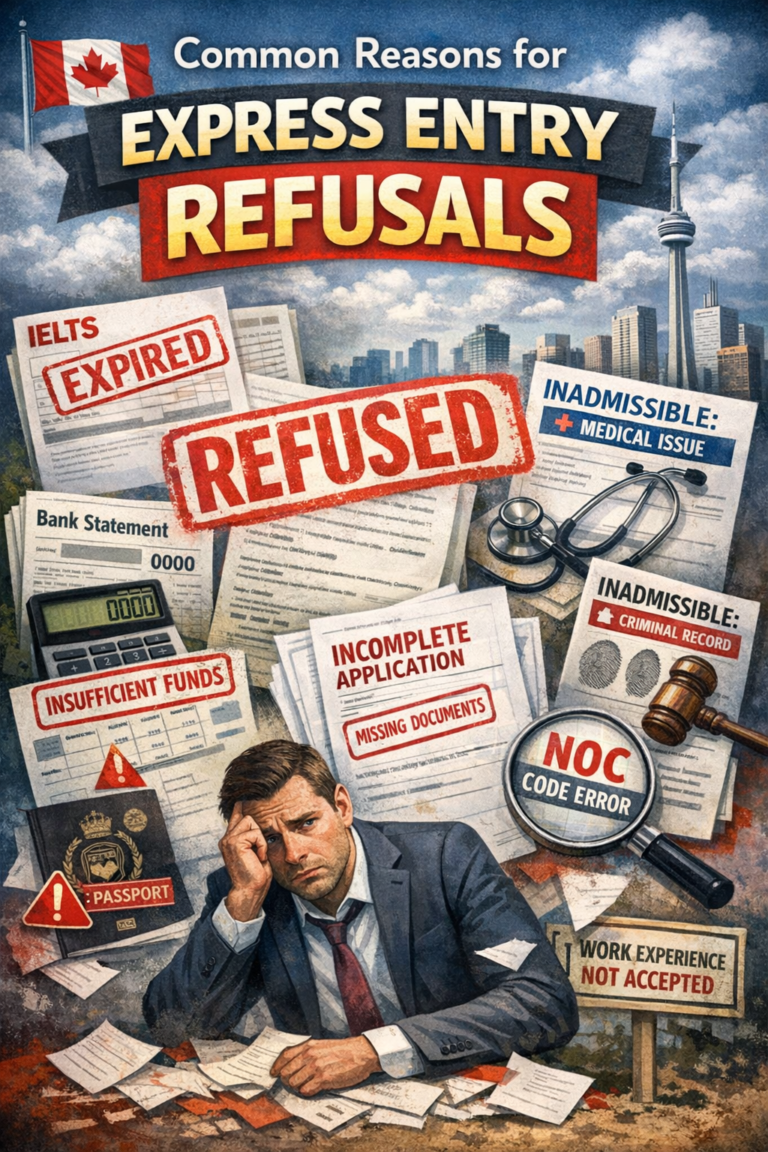
Your National Occupational Classification code is arguably the most important field in your entire profile. Get it wrong and you might claim the wrong amount of work experience points, disqualify yourself from category draws your occupation should qualify for, or worse — create a discrepancy that IRCC flags during document review.
The NOC system moved to the TEER (Training, Education, Experience and Responsibilities) framework in 2022. If you’re working from old information, double-check your code against the current NOC 2021 classification. We have a full guide on What is NOC and How to Find Your Code if you need to start there.
Claim Every Point You’re Actually Entitled To
This sounds obvious. It isn’t. Here are the points most commonly left unclaimed:
ECA education points. If you have a foreign degree and haven’t submitted it through an Educational Credential Assessment, you’re probably claiming insufficient education points. A Bachelor’s degree earns 112 CRS points. Without the ECA, you might be claiming 28 (high school equivalent) or nothing at all.
Sibling bonus. Have a brother or sister who’s a Canadian citizen or PR? That’s 15 CRS points. A lot of people forget to claim it.
Second language points. If you speak both English and French and have taken tests in both, make sure both are entered into your profile. The second language field adds up to 24 additional points depending on your score — and there’s a separate French bilingualism bonus on top.
Correct work experience type. The profile distinguishes between Canadian and foreign work experience, and between skilled (NOC TEER 0/1/2/3) and non-skilled work. Make sure you’re claiming the right categories.
Use the CRS Score Calculator to cross-check what you should be earning against what you’ve entered.
Don’t Overstate — IRCC Will Check
The temptation to inflate your profile is real, especially when you’re 20 points below a draw cutoff. Resist it.
If your Express Entry profile says you have 3 years of work experience in a specific occupation and your actual employment records show 2 years and 4 months — that’s a discrepancy IRCC will find when they review your documents post-ITA. At best, your application gets delayed while you provide additional evidence. At worst, your application gets refused and you may face a finding of misrepresentation, which can bar you from applying to Canada for 5 years.
Accurate is better than inflated. Always.
Your Language Test Has an Expiry Date
IELTS and CELPIP results are valid for 2 years from the test date — not from when you create your profile. If your test is approaching expiry and you’re still in the pool, you need to retake it before it expires or your profile becomes ineligible.
Check this right now if you haven’t recently. Expired language tests are one of the most common profile problems and one of the most avoidable.
Keep Your Profile Current
Your profile needs to reflect your current situation — not where you were when you first submitted it. Changed jobs? Update your work experience. Got a new language test result? Update the scores. Got married? Major update required.
A stale profile creates inconsistencies. Inconsistencies create problems during document review. And nobody wants problems at the document review stage — that’s 60 days in, you’re exhausted, you just want it done.
Set a reminder to review your profile every 90 days while you’re in the pool.
Get the Dates Right
Work experience dates, education dates, travel dates — IRCC is meticulous about this. Be precise. If you started a job on March 15 of a given year, enter March 15 — not “March” or “early 2023.”
Date inconsistencies between your profile and your supporting documents are a common trigger for additional document requests. It slows everything down. Be exact from the start.
Understand What “Full-Time” Means
For Express Entry work experience, full-time means at least 30 hours per week. Part-time work can count, but you need enough hours to add up to the equivalent of 30 hours/week over the relevant period.
This matters because a lot of people claim full-time experience based on their employment contract hours without checking whether any periods of reduced hours, unpaid leave, or irregular scheduling affect their calculation. Do the math carefully.
Think About Category Positioning
Since IRCC introduced category-based draws in 2023, your NOC code isn’t just an administrative detail — it’s potentially the thing that gets you an ITA at a lower cutoff than you’d need in an all-program draw.
Make sure your NOC code is as accurate as possible. And if your occupation could reasonably fall into multiple codes, consider which one best reflects your actual duties and which one IRCC has been drawing from in targeted rounds.
The Profile Is a Legal Document
This is worth saying plainly. Your Express Entry profile is a legal declaration. The information you put in it is the basis for your permanent residence application. Inaccuracies — even unintentional ones — can have serious consequences.
If you’re genuinely unsure about how to classify your occupation, education, or work experience, that’s exactly when a consultation with a Regulated Canadian Immigration Consultant (RCIC) or immigration lawyer is worth the money.
Requirements and classifications can change. Verify current IRCC requirements at the official IRCC website. Nothing here is immigration advice.