
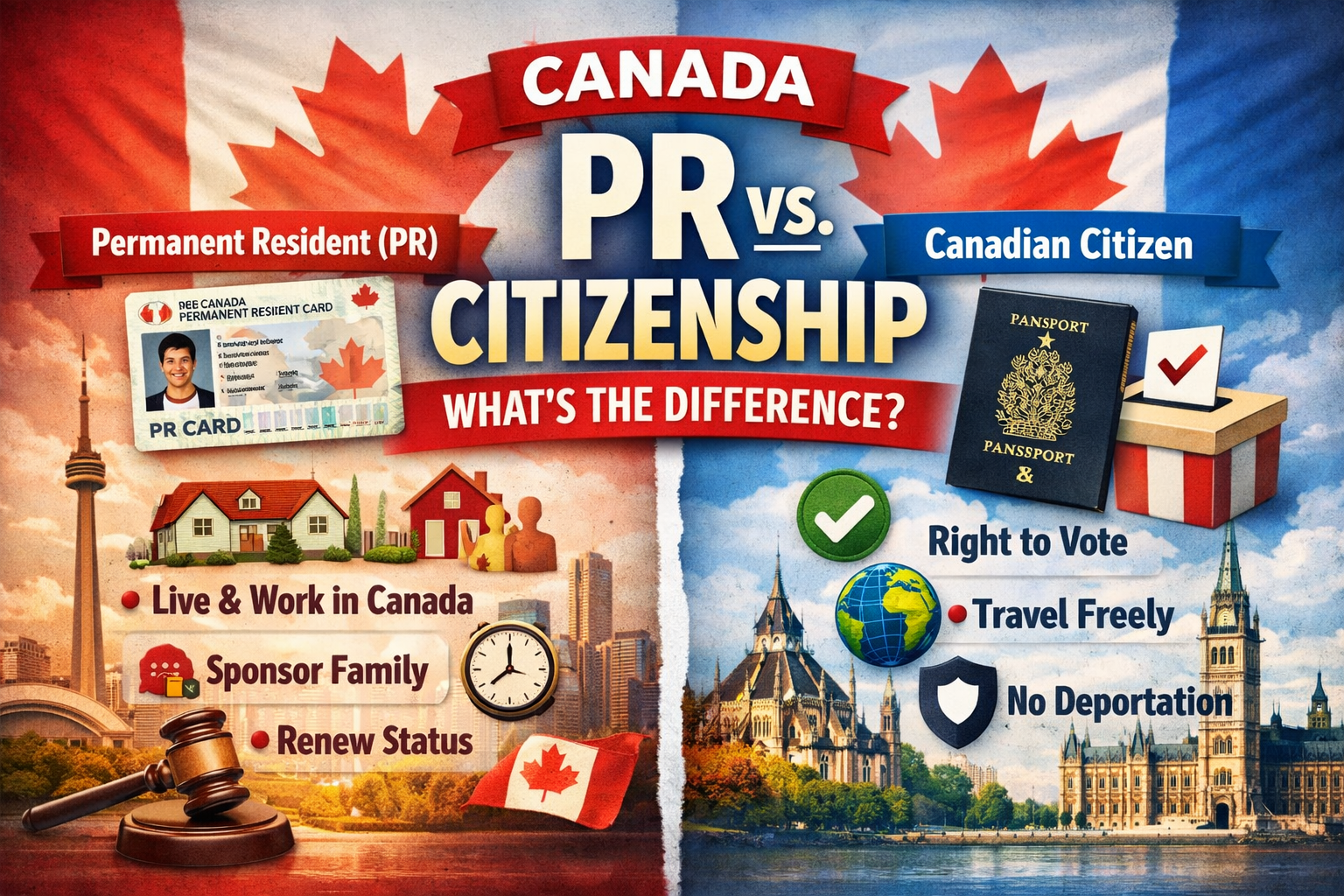
Canada PR vs Citizenship — What’s the Difference?
A lot of people use “PR” and “citizenship” interchangeably when they talk about immigrating to Canada. They’re not the same thing — not even close. The rights, obligations, and pathways are genuinely different, and understanding the distinction matters whether you’re just starting your Express Entry journey or you’ve been a permanent resident for a few years already.
Here’s the real breakdown.
What Permanent Residence Actually Is
Becoming a permanent resident means you’re allowed to live and work anywhere in Canada, indefinitely. You’re not a temporary worker anymore. You’re not on a visa that expires in two years. You have the legal right to be here.
What you get as a PR:
- Right to live and work anywhere in Canada
- Access to most federal and provincial government services, including healthcare
- The ability to sponsor eligible family members for PR
- Path to citizenship after meeting residency requirements
- Protection under Canadian law and the Canadian Charter of Rights and Freedoms
What you don’t get as a PR:
- A Canadian passport
- The right to vote in federal, provincial, or municipal elections
- Some jobs that require security clearance as a Canadian citizen
- Full protection from deportation if you commit certain serious crimes
That last one matters more than people realise. Permanent residence can be revoked. If a PR is convicted of a serious crime, they can be deported. Canadian citizens cannot be deported to their country of origin.
What Canadian Citizenship Actually Is
Citizenship is permanent. You can’t be deported. You vote. You can hold a Canadian passport — which, practically speaking, is one of the most powerful travel documents in the world, giving visa-free or visa-on-arrival access to over 180 countries.
What citizenship adds:
- Canadian passport
- Voting rights
- Protection from deportation
- Eligibility for all government jobs (including those requiring citizenship)
- Ability to pass Canadian citizenship to children born abroad
- Dual citizenship (Canada allows it — your other country may or may not)
The tradeoff: getting citizenship requires first getting PR and then meeting the physical presence requirement for naturalisation.
The Timeline From Arrival to Citizenship
Here’s roughly how it plays out:
Get PR — through Express Entry, PNP, family sponsorship, or another program. From submitting your Express Entry profile to receiving your Confirmation of Permanent Residence, you’re looking at roughly 6–18 months depending on the stream and processing times.
Maintain PR status — as a PR, you need to spend at least 730 days (2 years) in Canada in every 5-year period to maintain your status. This is called the residency obligation. Spend more time abroad than allowed and you risk losing your PR status.
Apply for citizenship — you can apply for citizenship after spending 1,095 days (3 years) in Canada as a PR within the last 5 years. Only time spent as a PR counts fully; time spent in Canada as a temporary resident (student, worker) counts at half rate.
Wait for processing — citizenship applications currently take roughly 12–24 months to process. This includes a citizenship test (knowledge of Canada’s history, values, and government) and a ceremony.
So the total minimum timeline: roughly 3 years as PR + citizenship processing. From first entering the Express Entry pool, the realistic timeline to citizenship is about 5–7 years for most people.
Do You Have to Become a Citizen?
No. Plenty of people live in Canada as permanent residents indefinitely without pursuing citizenship. There’s no requirement to become a citizen.
The reasons people typically pursue citizenship anyway:
- Canadian passport (significant travel advantage)
- Voting rights
- Absolute security — can’t lose status, can’t be deported
- Passing citizenship to children
- Emotional and symbolic significance of being Canadian
If you’re primarily here for work and lifestyle and you maintain strong ties to your home country — dual citizenship being an issue, for example — staying as a PR long-term is a perfectly valid choice.
The Practical Differences That Matter Day-to-Day
Honestly, for most day-to-day life in Canada, the difference between PR and citizenship is minimal. You work, pay taxes, use healthcare, rent or buy a home — all of this is essentially the same whether you’re a PR or citizen.
Where the difference shows up:
- Travel. PRs travel on their home country passport. Citizens travel on a Canadian passport. If your home country passport requires visas for a lot of destinations, this is significant.
- Residency obligation. PRs have to maintain the 730-day requirement. Citizens don’t — you can live abroad indefinitely without losing Canadian citizenship.
- Emergency consular assistance abroad. Canadian citizens get consular protection from Canadian embassies abroad. PRs have much more limited access to consular assistance.
- Voting. PRs don’t vote. If political participation in Canada matters to you, citizenship is the path.
A Common Misconception
Some people think getting PR automatically leads to citizenship after a certain number of years. It doesn’t. You have to separately apply and meet the requirements. Citizenship doesn’t happen automatically — you have to actively pursue it.
The Bottom Line
PR gets you into Canada and gives you a stable, full life here. Citizenship gives you permanence, a passport, and voting rights. Most people who pursue Canadian immigration eventually pursue both — PR first, citizenship a few years later.
If you’re at the beginning of this journey, the immediate goal is PR. Start with the CRS Score Calculator to understand where your Express Entry score stands, and go from there.
Immigration rules and citizenship requirements can change. Always verify current requirements at IRCC’s official website. Nothing here is immigration advice.