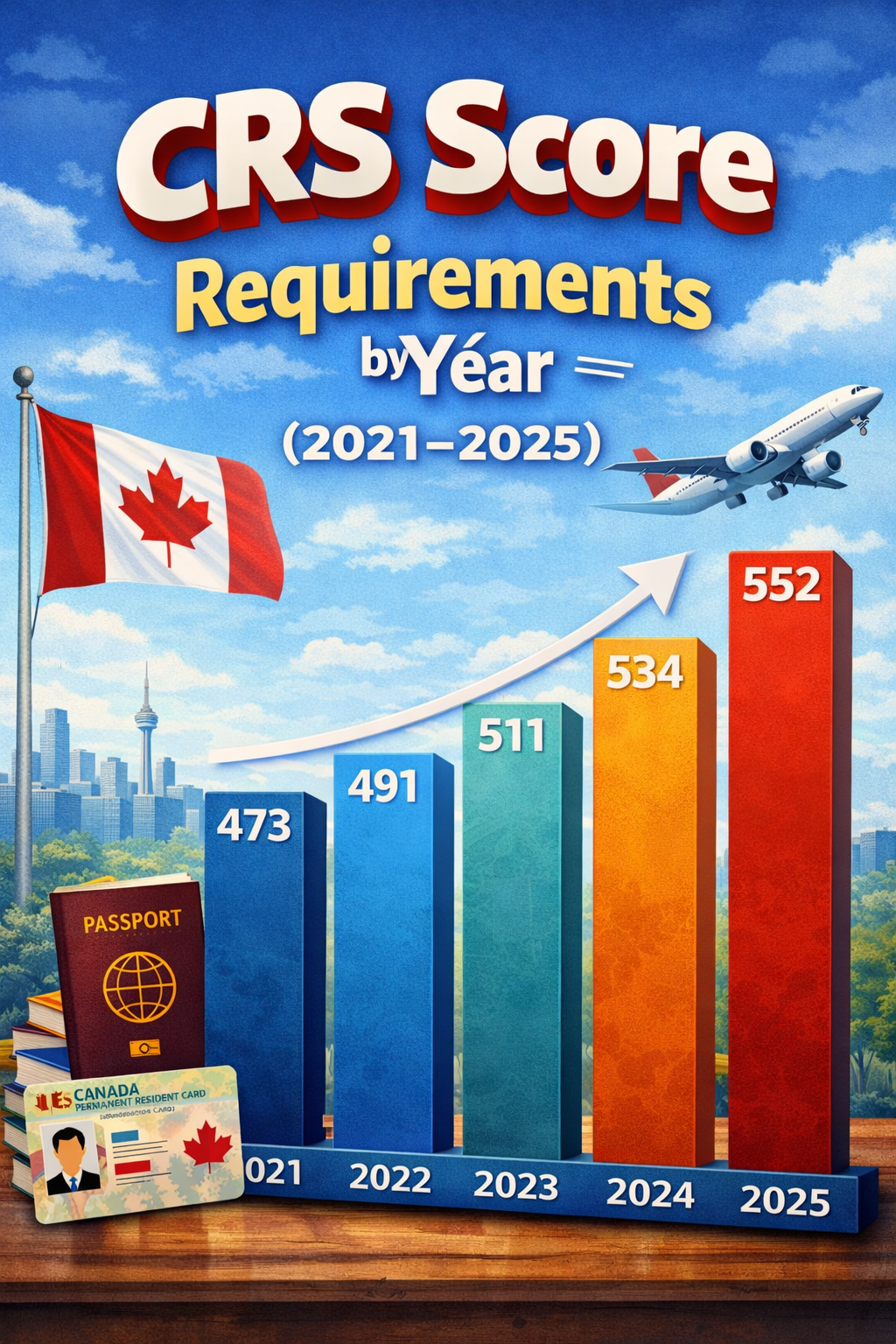
CRS Score Requirements by Year (2021–2025)
If you’ve been watching Express Entry draws for a while, you’ve noticed that cutoffs jump around in ways that can seem almost random. 491 one week, 525 the next, then suddenly a category draw hits at 379 for healthcare workers. It feels chaotic.
It’s not — there are real patterns underneath. And understanding those patterns is genuinely useful for figuring out where your score stands and what you’re actually waiting for.
Let’s go through it year by year.
Before We Start — How to Read This Data
A few things worth understanding before diving into the numbers:
The “lowest cutoff of the year” is almost always from either a very large draw or a category/PNP-specific round. Not a typical all-program draw. The high-end cutoffs reflect periods when the pool was stacked with strong candidates and draw volumes were smaller.Also — tiebreaking. When two candidates have identical CRS scores, IRCC uses the submission timestamp of your Express Entry profile as the tiebreaker. The published cutoff is technically the lowest score that received an ITA, including the lucky person at that exact score who submitted their profile earliest. Something to keep in mind.
2021 — The Pandemic Bounce (And Those Insane Mega-Draws)
2021 was completely unlike any other year. Canada had essentially paused Express Entry draws through most of 2020 because of COVID-19 processing backlogs. By early 2021, the pool was stuffed with candidates who’d been waiting for over a year.
IRCC’s response: enormous mega-draws to clear the backlog. We’re talking rounds that invited 27,000+ candidates at once. The cutoffs during those draws dropped to genuinely surreal levels — as low as 75 in one round. Seventy-five. For context, a normal all-program cutoff sits around 480–520.
Outside those extraordinary rounds, regular draws in 2021 ran with cutoffs in the 400–480 range. But those mega-draw numbers get shared around a lot and give people a wildly misleading picture of what’s “possible.” Don’t benchmark against 2021.
The honest 2021 picture:
- Mega-draws (clearing the backlog): cutoffs as low as 75
- Regular all-program draws: approximately 400–480
- CEC-specific draws: approximately 357–462
2022 — Back to Normal, Then a Strange Pause
As the mega-draws cleared the pile, cutoffs climbed back to what you’d expect. Through the first half of 2022, all-program draws ran with cutoffs in the 480–521 range — more like pre-pandemic Express Entry.
Then IRCC essentially stopped running all-program draws in the second half of 2022. They were transitioning toward the category-based draw system and there was a kind of holding pattern while that transition happened. A lot of candidates in the pool during that period had to just… wait. With rising scores and no draws to enter.
It was frustrating. And it spooked people into thinking Express Entry was permanently tightening. It wasn’t — it was a transition.
The honest 2022 picture:
- All-program draws (H1): approximately 480–521
- H2 2022: draws largely paused for system transition
- CEC draws: approximately 439–557
2023 — The Category Draw Era Changes Everything
This is where things got genuinely interesting. Category-based draws launched properly in 2023 and immediately changed how Express Entry worked for a lot of candidates.
First category draws ran in mid-to-late 2023. Healthcare workers saw draws in the 430s. French speakers got targeted draws around 470. STEM occupations and trades categories followed. And the crucial thing — these cutoffs were meaningfully lower than the all-program draws running at the same time.
So suddenly the question wasn’t just “is my CRS score high enough?” — it was also “does my occupation or profile match a category IRCC is actively targeting?”
All-program draws continued through 2023 with cutoffs roughly in the 481–541 range. But category draws became the path for anyone who couldn’t crack that threshold.
The honest 2023 picture:
- All-program draws: approximately 481–541
- Healthcare category draws: approximately 430–445
- French/bilingual draws: approximately 470–479
- Trades draws: approximately 388–436
- STEM draws: first rounds, approximately 481–491
Use the CRS Score Calculator to see how your score compares against these ranges.
2024 — Category Draws Become Routine
By 2024, category draws weren’t novel anymore — they were a regular part of how Express Entry ran. IRCC settled into a rhythm: all-program draws mixing with category rounds targeting specific occupations and French speakers.
A few patterns that became very clear this year:
French is disproportionately valuable. French-language draws ran consistently with lower cutoffs than all-program rounds. If you speak French and haven’t tested formally, 2024’s data makes the argument better than any article can.
Trades got real attention. Electricians, plumbers, welders — TEER 2 and 3 occupations — had their own dedicated draws with cutoffs well below the all-program threshold. If you’re FST-eligible, this matters a lot.
All-program cutoffs stayed consistent. The general draw cutoffs in 2024 sat in the 494–540 range — similar to 2023, no dramatic shift up or down.
The honest 2024 picture:
- All-program draws: approximately 494–540
- Healthcare category draws: approximately 430–470
- French/bilingual draws: approximately 336–479
- Trades draws: approximately 433–436
- STEM draws: approximately 481–491
For anyone who might qualify for the Canadian Experience Class — check the CEC Points Calculator. CEC draws often had lower cutoffs than all-program rounds throughout 2024.
2025 — Steady, With a Few Surprises
2025 continued the category draw rhythm without dramatic system-level changes. A couple of things worth noting:
The pool got more competitive in certain categories as candidates specifically optimised their profiles for targeted draws — testing in French, ensuring correct NOC codes, etc. Competition within categories picked up.
All-program cutoffs fluctuated between approximately 489–549 depending on draw size. No dramatic departure from 2024.
Agriculture and agri-food draws remained the most accessible for candidates with relevant occupations — some with cutoffs in the low 300s, which is astonishing compared to all-program draws.
The honest 2025 picture:
- All-program draws: approximately 489–549
- Agriculture/agri-food: some draws as low as mid-300s
- Healthcare: approximately 431–475
- French/bilingual: approximately 336–421
- STEM: approximately 481–510
What Five Years of Data Actually Tells Us
Look at all of this together and a few things jump out clearly:
480–520 is consistently where all-program draws land. With exceptions, that’s been the range for most of Express Entry’s recent history. If you’re targeting all-program draws, that’s your benchmark.
Category draws are real and meaningful. For candidates with specific occupations or French skills, the category system has opened draws with cutoffs 50–100 points below the all-program threshold. This isn’t a hack — it’s exactly how IRCC designed the system.
The PNP + Express Entry combination works. The +600 point nomination bonus put candidates above every draw cutoff across this entire five-year period. That’s not changing.
Waiting for cutoffs to “just drop” is not a strategy. Cutoffs move based on pool composition and draw size — they don’t trend steadily downward. Passive waiting is a gamble.
Looking Ahead to 2026
If you’re at 500+, you’re competitive for all-program draws. Expect an ITA within a reasonable window.
If you’re at 450–500, category draws and PNP-linked rounds are your path. Figure out which categories apply to you.
Below 450? A provincial nomination is your most reliable route. Investigate PNP streams that match your occupation and location — this is where your energy belongs, not in watching draw cutoffs every two weeks.
Draw cutoff data based on IRCC’s published Express Entry results. Always verify current data directly with IRCC. Not immigration advice.