Common Reasons for Express Entry Refusals
Nobody applies for Canadian PR expecting to get refused. But it happens — more often than the immigration blogs would have you believe. And a lot of the time, the reasons are entirely preventable.
Here’s an honest look at why Express Entry applications get refused, and what to actually do about each one.
1. Misrepresentation — The Most Serious One
This is the big one. If IRCC determines that you provided false, misleading, or incomplete information in your application — whether intentionally or not — they can refuse your application and bar you from applying to Canada for 5 years.
Five years. For what sometimes amounts to an accidental inconsistency.
What triggers a misrepresentation finding?
- Work experience that doesn’t match your employment records
- Education credentials that don’t align with your ECA report
- Travel history gaps or omissions
- Family members not disclosed
- Criminal history not declared
The rule is simple: if you’re not sure whether something needs to be disclosed, disclose it. The consequences of omitting information are catastrophic compared to the minor inconvenience of including something that turns out not to be relevant.
2. Expired Language Test
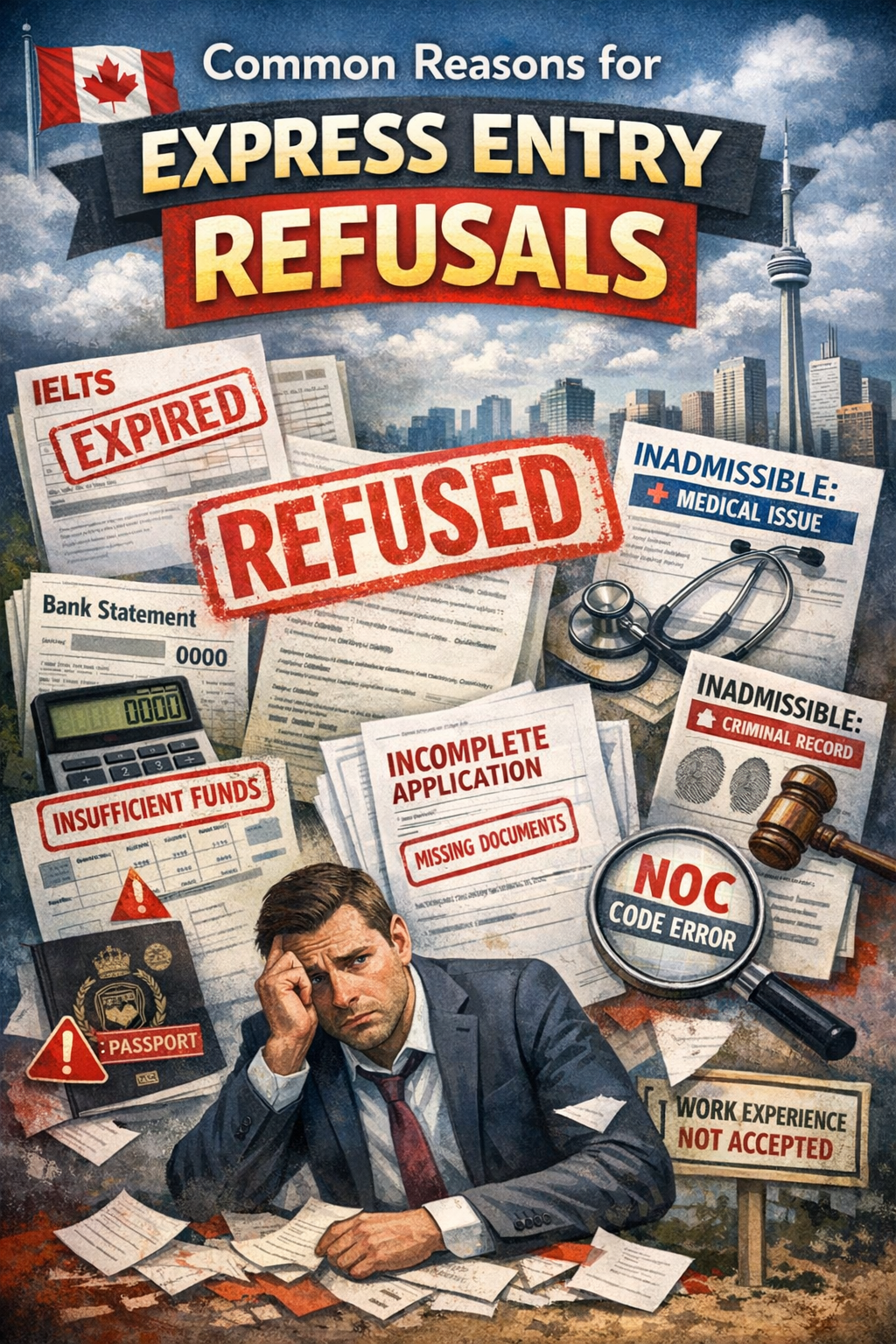
Your IELTS or CELPIP results are valid for 2 years from the test date. If they expire while your profile is in the pool — or worse, after you’ve received an ITA but before IRCC finishes processing your application — your application is in trouble.
This one is so avoidable it’s almost painful. Check your test expiry date right now. If it’s within the next 6 months and you haven’t gotten an ITA yet, consider booking a retake.
3. Insufficient Funds
If you don’t have a qualifying Canadian job offer, you need to show proof of funds — enough money to settle in Canada. The exact amount is tied to family size and updated annually by IRCC.
The trap: bank statements that look sufficient on paper but have a brief dip below the required threshold at some point during the relevant period. Or funds in currencies that create confusion about the actual CAD value. Or funds in an account that isn’t easily provable as yours.
Make sure your settlement funds are clearly documented, clearly in your name, and clearly above the required threshold consistently.
4. Inadmissibility — Medical
The immigration medical exam isn’t just a formality. IRCC assesses whether your health condition would cause excessive demand on Canada’s health or social services. Certain conditions can result in medical inadmissibility.
This is less common than the other reasons on this list, but it does happen. If you have a pre-existing medical condition, it’s worth understanding how the excessive demand policy works before you’re deep into an application. An immigration lawyer with relevant experience can help assess risk.
5. Inadmissibility — Criminal
Having a criminal record doesn’t automatically bar you from Canada. What matters is how that offence would be classified under Canadian law, and whether enough time has passed for you to be considered rehabilitated.
A lot of people assume a minor offence from years ago doesn’t matter. Sometimes it doesn’t. Sometimes it does. And not disclosing it matters enormously — see point one.
If you have any criminal history anywhere in the world, get proper legal advice before submitting your application. Don’t guess.
6. Document Inconsistencies
IRCC is very good at spotting when the information in your permanent residence application doesn’t match your Express Entry profile, and when your supporting documents don’t match either.
Employment start and end dates that differ by even a few months. An educational credential that contradicts your ECA report. A job title that doesn’t match the NOC code you claimed. These inconsistencies trigger requests for additional documentation — and in some cases, they result in refusal if you can’t satisfactorily explain them.
The fix: be meticulous. Review every date, every employer name, every credential claim against your actual documents before you submit.
7. Incomplete Application
Submitting an incomplete application is surprisingly common. Missing documents, missing signatures, forms not filled out in full — any of these can result in your application being returned or refused without a full review.
The 60-day post-ITA window is stressful and busy. It’s easy to miss something. Use a checklist. IRCC provides a document checklist in your application portal — use it, but also verify each item against their current requirements on the IRCC website rather than assuming the automated checklist is exhaustive.
8. NOC Mismatch
If the work experience you’ve claimed in your profile doesn’t actually match the NOC code you’ve used to earn those points, you’ve got a problem. IRCC will assess your job duties against the NOC description. If the fit is weak — if you called yourself a software engineer but your actual duties were mostly data entry — that work experience won’t be accepted.
This isn’t about job titles. It’s about actual duties. Be honest and accurate about what you actually did.
9. Work Experience That Doesn’t Count
Not all work counts for Express Entry purposes. Self-employment income without proper documentation, volunteer work, casual or irregular work, work in non-qualifying NOC categories, or work experience obtained illegally (working without authorization in Canada) — none of this counts.
If you’re counting on specific work experience for your eligibility or your CRS score, make absolutely sure it actually qualifies before submitting.
10. Failure to Meet the Express Entry Eligibility Requirements
This one sounds obvious, but it’s worth saying. People sometimes enter the Express Entry pool believing they meet the minimum requirements for their chosen stream (FSW, CEC, or FST) and don’t. They get an ITA, submit the application, and IRCC discovers during document review that the eligibility was never there to begin with.
Use the CRS Score Calculator and stream-specific eligibility tools to double-check your eligibility before entering the pool — not after you’ve gotten an ITA.
If You’ve Already Been Refused
A refusal isn’t necessarily the end. Depending on the reason, you may be able to reapply immediately (fixing whatever caused the refusal), request reconsideration in some circumstances, or appeal through the Federal Court. The right path depends on the specific reason for refusal and your situation.
If you’ve been refused, get proper legal advice. This is exactly when an RCIC or immigration lawyer earns their fee
Nothing in this article is immigration advice. If you’re facing a refusal or complex admissibility situation, consult a Regulated Canadian Immigration Consultant (RCIC) or immigration lawyer.