What Happens After You Get an ITA?
Getting an Invitation to Apply is — genuinely — one of the best emails you’ll ever receive. But the celebration window is short. Because once that ITA lands in your inbox, a 60-day clock starts. And what you do in those 60 days determines everything.
Here’s what actually happens next, step by step.
Day 0 — You Get the ITA
IRCC sends your Invitation to Apply through your Express Entry account, not by email directly. You’ll get a notification, but the actual ITA is in the portal. Log in, read it carefully, and note the exact deadline date — 60 days from the date of issue, not the date you read it.
Sixty days sounds like plenty of time. It isn’t, especially if you’re missing documents or need to book medical exams. Start immediately.
Step 1 — Accept the Invitation
In your IRCC account, you formally accept the ITA and begin filling out your permanent residence application. If you decline or don’t respond within the 60 days, the invitation expires and you’re back in the pool — your CRS score stays the same but you’ll need to wait for another draw.
Don’t let it expire. It happens, and it’s heartbreaking.
Step 2 — Gather Your Documents
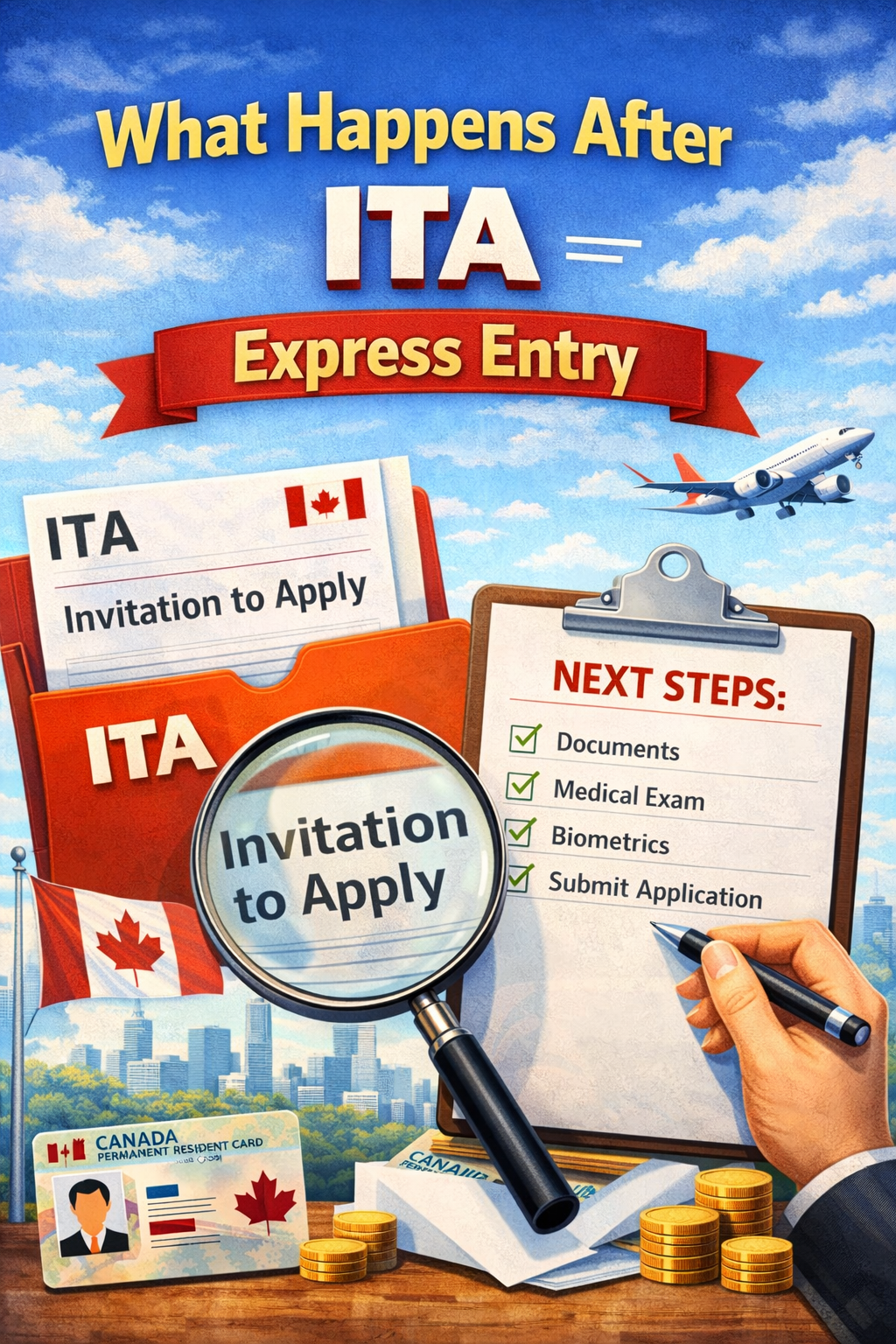
This is where most of the 60 days actually goes. IRCC needs a lot:
Identity documents — valid passport (must be valid for the duration of your intended stay), national ID cards, and any previous passports if they show relevant travel history.
Travel history — you’ll need to account for travel to certain countries, particularly in the past 10 years.
Work experience proof — reference letters from employers, pay stubs, tax documents, or employment contracts. These need to cover the work experience you claimed in your Express Entry profile. If you said you had 3 years of experience, you need documents proving 3 years.
Language test results — your IELTS, CELPIP, TEF, or TCF scores. If they’ve expired (tests are valid for 2 years), this is a major problem. It should have been caught before you submitted your profile, but if it wasn’t — urgent.
Educational Credential Assessment (ECA) — if you claimed points for a foreign degree, you need your ECA report.
Police certificates — from every country you’ve lived in for 6+ months since age 18. These can take weeks to arrive from some countries. Start requesting them immediately.
Medical exam — you need an immigration medical exam conducted by an IRCC-designated panel physician. Find one near you on IRCC’s website, book as early as possible. Results are valid for 12 months.
Proof of funds — unless you have a valid Canadian job offer, you need to show you have enough settlement funds. The required amount changes annually (check IRCC’s current tables), but for a single applicant in 2026 it’s in the range of CAD $14,000–$15,000.
Step 3 — Complete the Application and Pay the Fees
Once your documents are gathered, you complete the online application in your IRCC account. The application fee for permanent residence through Express Entry is currently CAD $1,365 per adult, plus $230 per dependent child. There’s also a Right of Permanent Residence Fee of $515 per adult, which you can pay upfront or upon approval — most people pay upfront to keep things simple.
Submit the application before the 60-day deadline. Not on day 59 if you can help it — technical issues happen.
Step 4 — IRCC Processes Your Application
After submission, the 60-day sprint turns into a waiting game. Express Entry is designed to process applications in 6 months or less for most applicants — that’s the whole point of the system. In practice, processing times vary. Complex cases, missing documents, or security/background check delays can extend it.
What IRCC is actually checking:
- That your documents match what you claimed in your Express Entry profile
- Your criminal background (police certificates play a role here)
- Your medical admissibility (from the medical exam)
- Security checks
- Identity verification
If something doesn’t line up between your profile and your documents, you might receive an additional document request (ADR) — IRCC will ask you to provide specific additional evidence. Respond promptly and completely.
Step 5 — Confirmation of Permanent Residence (COPR)
If everything checks out, IRCC issues a Confirmation of Permanent Residence (COPR) and, if needed, a permanent resident visa (for those who require one to enter Canada).
If you’re already in Canada on a valid status, you’ll go through a “soft landing” process with a border officer who activates your PR status. If you’re outside Canada, you’ll need to enter Canada before the date on your COPR.
A Few Things People Often Get Wrong
Not updating your profile before submitting. If anything changed between when you created your Express Entry profile and when you’re submitting your PR application — new job, new address, change in marital status — you need to update accordingly. Inconsistencies are a red flag.
Underestimating police certificate wait times. Some countries take months. Philippines, India, Nigeria — these can be slow. Start requesting on day one. Not day 30.
Booking the medical exam too late. Exams need to be done by a designated physician and results sent electronically to IRCC. The whole process can take 1–2 weeks. Book it in the first week.
Ignoring proof of funds. This trips people up surprisingly often. Make sure your bank statements are current (usually within the past 6 months) and clearly show the required balance.
The Bottom Line
Getting an ITA is huge. But it’s the beginning of a process, not the end of one. The 60-day deadline is real, the document requirements are real, and the preparation you do in those first two weeks determines how smoothly the rest goes.
Start the medical exam booking and police certificate requests on day one. Everything else can follow, but those two have the longest lead times.
Processing timelines and fee amounts can change. Always verify current requirements at IRCC’s official website. Nothing in this article is immigration advice.