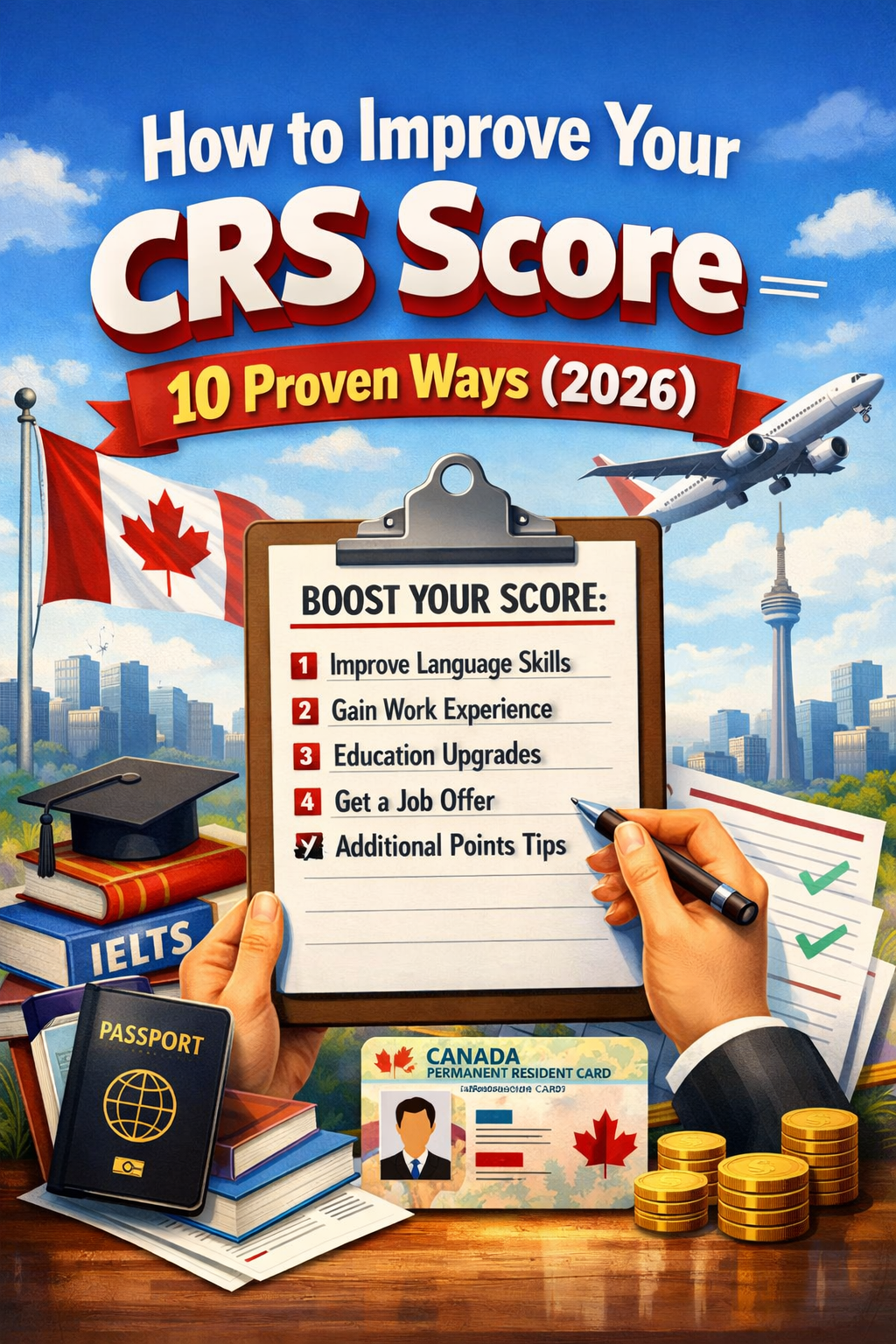
How to Improve Your CRS Score — 10 Proven Ways (2026)
Most people who aren’t getting ITAs are stuck in one of three situations: their score isn’t high enough, they’re waiting for something to change on its own, or they just don’t know what actually moves the needle.
This is for all three groups.
Before you read further — open the CRS Score Calculator in another tab and run your current profile. Knowing exactly which factors are pulling your score down makes everything below way more actionable.
1. Retake Your Language Test
Number one for a reason. Language is one of the highest-weighted factors in the whole CRS formula — and unlike age, it’s something you can actually change.
The gap between CLB 7 and CLB 9 across all four skills is 16 CRS points. To put that in perspective: that’s roughly the same gain as going from one year to three years of Canadian work experience. For most people below competitive cutoffs, language is where the low-hanging fruit is.
Even improving a single weak skill matters. If you’re at IELTS 6.5 in Writing but 7.0 everywhere else, pushing Writing to 7.0 gets you to CLB 9 across the board — 2 extra points right there. Small, but real. And a lot of small gains add up fast.
Do this: Book a retake. Focus prep on your weakest skill specifically. And if you’ve only ever tested in English, check whether you have workable French — that opens the second language bonus.
2. Get a Provincial Nomination
The single most powerful thing you can do. A provincial nomination adds 600 CRS points — not a typo, not an exaggeration.
If your base score is 420 and you feel completely stuck, a PNP takes you to 1,020. Every single draw cutoff in Express Entry history has been below 1,000. So practically speaking, a nomination is a guaranteed ITA.
Yes, nominations aren’t just handed out. Each province has its own criteria, and you often need some connection to that province — an employer, prior experience, education there. But if your occupation is on a provincial priority list, or if you’ve spent time working in a particular province, this is absolutely worth researching seriously. Not “I’ll look into it someday.” This week.
3. Build Canadian Work Experience
One year of Canadian skilled work adds 40 direct CRS points. Two years adds 53. Three years adds 64. And that’s before transferability bonuses kick in on top.
If you’re already in Canada on a work permit — your score is quietly building whether you’re paying attention to it or not. That’s genuinely good news.
Once you hit one year of Canadian skilled work, check the CEC Points Calculator. You might qualify for the Canadian Experience Class, which has its own dedicated draws — sometimes with lower cutoffs than all-program rounds.
4. Complete Your Educational Credential Assessment (ECA)
If you have a foreign degree and haven’t submitted it through an ECA yet, this might be the easiest points you’re leaving behind.
A Bachelor’s degree earns 112 CRS points under education. A Master’s earns 126. Without an ECA from a designated organisation like WES or IQAS, IRCC can’t credit your foreign education at all — you might be claiming the equivalent of a high school diploma (28 points) when you should be getting 112. That’s an 84-point difference. Which is kind of insane when you think about it.
The process takes a few months and costs some money. It’s worth it.
5. Test in Your Second Language
A lot of people who speak both English and French never bother testing in their weaker language. That’s often a mistake.
Scoring CLB/NCLC 7+ in your second language across all four skills adds up to 24 extra CRS points. If you hit NCLC 7+ in French with English at CLB 5+, there’s also a separate bilingualism bonus on top — up to 50 additional points.
If you grew up bilingual or took French seriously in school, this test is almost certainly worth your time. Even moderate scores can add 4–12 meaningful points.
6. Claim Your Canadian Sibling Bonus
Simple one. If you have a brother or sister who’s a Canadian citizen or permanent resident and they’re 18 or older — that’s 15 extra CRS points you can claim.
Not life-changing on its own. But if you’re 10–12 points below a draw cutoff, it might be exactly what you need. Check your profile. If it applies, claim it.s
7. Get a Qualifying Job Offer
A valid Canadian job offer adds either 50 or 200 CRS points, depending on the NOC level. Senior management positions (NOC TEER 0) earn 200 points. Most other eligible positions earn 50.
The key word is qualifying — it needs to meet IRCC’s specific criteria, which typically includes LMIA support or a specific exemption. An informal offer letter from a Canadian employer isn’t enough. But if you’re already working in Canada and your employer is open to supporting your PR process, it’s worth a serious conversation.
8. Watch for Category-Based Draws That Match You
Since 2023, IRCC runs draws specifically targeting healthcare workers, STEM professionals, tradespeople, French speakers, agriculture workers, and others. These regularly produce lower cutoffs than all-program draws — sometimes by 40–60 points.
This isn’t something you change about yourself — it’s about making sure your profile correctly reflects your occupation and that you’re positioned for the draws that apply to you. If your NOC code falls into a category IRCC keeps targeting, you might get an ITA at a score that wouldn’t cut it in a general draw.
9. Optimise Your Spouse’s Profile
If you’re married or common-law and your partner is coming with you, their profile contributes CRS points too.
Your spouse’s education adds up to 10 points. Their language score adds up to 20. Their Canadian work experience adds up to 10. That’s up to 40 extra points available from your partner alone.
If your spouse hasn’t taken a language test yet, that’s potentially 20 points sitting unclaimed. Do the test. It’s worth it.
10. Time Your Application Around Your Birthday
Sounds strange, but it’s real math. CRS age points decline after 29 — by 5 to 11 points per year depending on your specific age. If your profile is ready and you’re approaching a birthday that drops you 6 or 11 points, submitting before that date rather than after is just smart timing.
This doesn’t mean rushing a profile that isn’t ready. But if everything is in order and you’re two weeks from a birthday — don’t wait.
The Real Point
CRS improvement usually isn’t one massive move. It’s several smaller gains that compound. Better language (+16), ECA for a Master’s instead of Bachelor’s (+14), second language test (+8–12), sibling bonus (+15) — that’s 50+ points without a job offer or PNP. Often the difference between stuck and invited.
Run the CRS Score Calculator with your real numbers, then run it again with your improved-profile scenarios. You’ll see exactly how close you might be — and it’s usually closer than people expect.
CRS scoring rules can change. Always verify current IRCC criteria before making immigration decisions. Not immigration advice.