
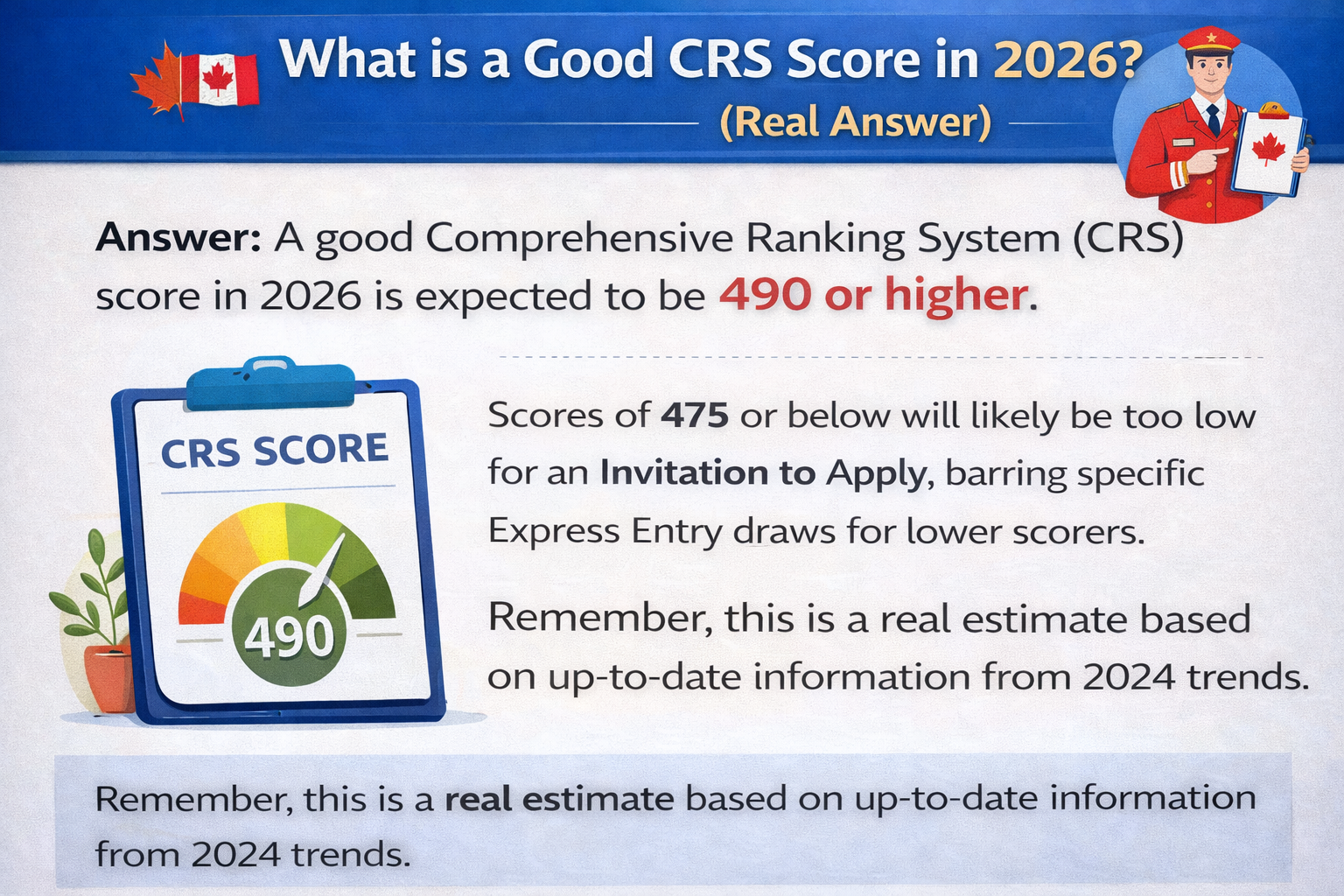
What is a Good CRS Score in 2026?
Here’s the honest answer: it depends. And I know that’s annoying to hear, but stick with me — because by the end of this you’ll know exactly where your score stands and what to actually do about it.
The short version? In 2026, a CRS score above 480 puts you in genuinely competitive territory for most Express Entry draws. Above 500 and you’re sitting pretty. Below 450? You’re not out of options — but you need a strategy, not just patience.
Let me break this down properly.
Why There’s No Single “Good” Number
Express Entry isn’t like a university entrance exam where you need a specific score to get in. The cutoff changes with every draw — sometimes dramatically. A score of 491 might get you an ITA one week, and the next draw the cutoff is 525. It’s a moving target.
What drives the cutoff up or down? A few things:
The size of the draw. When IRCC issues 5,000+ invitations in one round, the cutoff drops because they’re pulling deeper into the pool. Smaller draws mean higher cutoffs.
Who’s in the pool. If a wave of high-scoring candidates entered the pool recently, competition stiffens. If a lot of people got ITAs and left the pool, it loosens up.
Category-based draws. Since 2023, IRCC runs targeted draws for specific groups — healthcare workers, STEM professionals, tradespeople, French speakers. These often have lower cutoffs than all-program draws. If your occupation falls into one of these categories, your target score is different from everyone else’s.
So when someone asks “is 470 a good CRS score?” — the real answer is: it depends on which draw you’re waiting for.
The Actual CRS Score Benchmarks for 2026
Based on draw patterns going into 2026, here’s a realistic picture:
Below 400 — This is genuinely difficult territory for all-program draws. Not impossible (there have been draws in the 350s for specific programs), but you’d be relying on a provincial nomination or a very targeted category draw. The PNP adds 600 points, which changes everything — but without it, you’re waiting a long time.
400–450 — Getting closer, but still below where most general draws land. A PNP is your fastest path. Or a category-based draw if your occupation qualifies. Don’t just sit in the pool hoping the cutoff drops to you — it might, but it might not.
450–480 — This is the “almost there” zone. You’re competitive in many category draws and some all-program draws during high-volume periods. Worth being in the pool and watching draws closely.
480–520 — Solid. You’ll likely get an ITA through an all-program draw within a reasonable timeframe, assuming you’re Express Entry eligible and your profile is complete. This is where most successful candidates land.
520+ — Excellent. You’re at or above the cutoffs for virtually all recent draws. If you’re here and you haven’t gotten an ITA yet, double-check that your profile is actually complete and eligible.
What Actually Moves Your CRS Score
Before you panic about your number, it helps to know which factors you can actually change. Use the CRS Score Calculator to see your exact breakdown — but here’s the quick version:
Language scores are the highest-impact factor you can actively improve. The difference between CLB 7 and CLB 9+ across all four skills is potentially 16 points. That’s real. If you haven’t already, retaking your language test is almost always worth it.
Canadian work experience is massive. One year of Canadian skilled work adds 40 CRS points directly — plus transferability bonuses on top of that. If you’re already in Canada on a work permit, this is building while you wait.
Education is harder to change quickly, but if you have a foreign degree that you haven’t put through an Educational Credential Assessment (ECA) yet — do that. A Bachelor’s degree earns 112 CRS points. A Master’s earns 126. Some people leave 14 points on the table because they didn’t bother with the ECA.
Provincial nomination is the nuclear option — in a good way. A PNP adds 600 CRS points. It doesn’t matter if your base score is 350 or 450, a nomination puts you at 950+ and guarantees an ITA. If your score is stuck below competitive territory, this is the path to focus on.
A Note on “Average” CRS Scores
You’ll see statistics floating around about “average” CRS scores in the pool. In 2025, the average was somewhere around 500–510. But that number is a bit misleading — it includes a huge range of profiles, including people who are barely eligible and people with near-perfect scores.
What matters more than the average is the cutoff — the minimum score that received an ITA in a given draw. And those fluctuate. The lowest all-program cutoffs in recent memory have been in the low 400s during unusually large draws. The highest have pushed past 560 during periods of tight supply.
If you want the most current draw history, check IRCC’s official Express Entry draw results page regularly. Draw cutoffs are published after every round.
If Your Score Isn’t “Good” Yet — What Now?
Don’t just sit in the pool and hope. That’s the worst strategy. Here’s what to actually do:
First, use the CRS Score Calculator to get your real number with a full breakdown. A lot of people are surprised — either higher or lower than they expected — once they see the complete picture.
Second, check if you qualify for CEC. The Canadian Experience Class often has lower draw cutoffs than the all-program draws, and if you have at least one year of Canadian skilled work experience in the last three years, you might be eligible. The CEC Points Calculator will tell you in about two minutes.
Third, investigate PNP streams that match your occupation and location. This is honestly where most people with below-cutoff scores should be focusing their energy.
The Bottom Line
A “good” CRS score in 2026 is one that gets you an ITA within a timeframe that actually works for your situation. For most people, that means 480+ for all-program draws, or knowing which category or PNP stream gives you the best shot at a lower cutoff.
Don’t obsess over hitting a specific number. Understand your options, build the strongest profile you can, and work the system strategically. That’s what actually gets people to Canada.
Disclaimer: CRS draw cutoffs change with every round. The numbers in this article reflect patterns as of early 2026 and may not reflect the most recent draws. Always check IRCC’s official website for current draw data.