
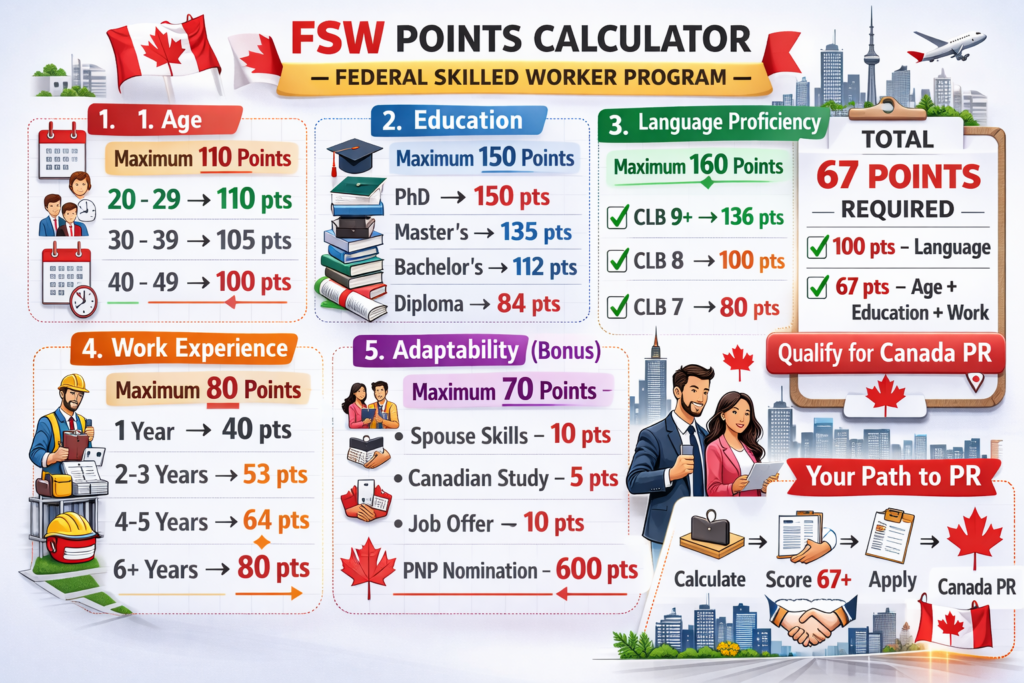
FSW Points Calculator — Federal Skilled Worker Program
Find out if you qualify for Canada’s Federal Skilled Worker program and calculate your full Express Entry score — both in one free tool. No signup, no waiting.
What Is the Federal Skilled Worker Program?
The Federal Skilled Worker program is Canada’s main Express Entry stream for skilled workers who don’t yet have Canadian work experience. If you’re applying from overseas — or if you’re in Canada on a work or study permit but haven’t accumulated enough time to qualify for CEC — FSW is almost certainly the stream you need to understand first.
Unlike the Canadian Experience Class, FSW uses a 67-point selection grid to determine eligibility. You need to score at least 67 out of 100 points across six factors: language, education, work experience, age, arranged employment, and adaptability. Fall short of 67 and you can’t enter the Express Entry pool through FSW — period.
Once you’re in the pool, though, the game changes. From that point, your CRS score is what matters, just like everyone else. FSW is the gate; CRS is the race.
Our FSW points calculator handles both stages. It calculates your selection grid score in real time as you fill in the form, tells you whether you meet the 67-point threshold, and then produces your full CRS score so you know where you stand in the pool.
FSW Points
Calculator
Find out if you qualify for Canada’s Federal Skilled Worker program and get your full Express Entry CRS score — both in one free tool.
Official Language Proficiency
First and second official language (English / French)
Education
Highest credential — Canadian or foreign (ECA required for foreign)
Work Experience
Skilled work — NOC TEER 0, 1, 2 or 3 (Canadian + foreign both count for FSW)
Age
FSW age factor + CRS age points
Arranged Employment
Valid LMIA-supported or LMIA-exempt Canadian job offer
Adaptability
Ties to Canada — capped at 10 points total regardless of how many apply
Additional CRS Factors
PNP, marital status, French bonus, sibling in Canada
Free • Instant • No signup required
—
—
Your CRS Express Entry Score
—How to Strengthen Your Score
Let’s Build Your Canada Strategy
Our immigration team reviews your full profile, identifies your best pathway, and gives you a clear action plan — not just a number.
The FSW 67-Point Selection Grid — What You’re Actually Being Scored On
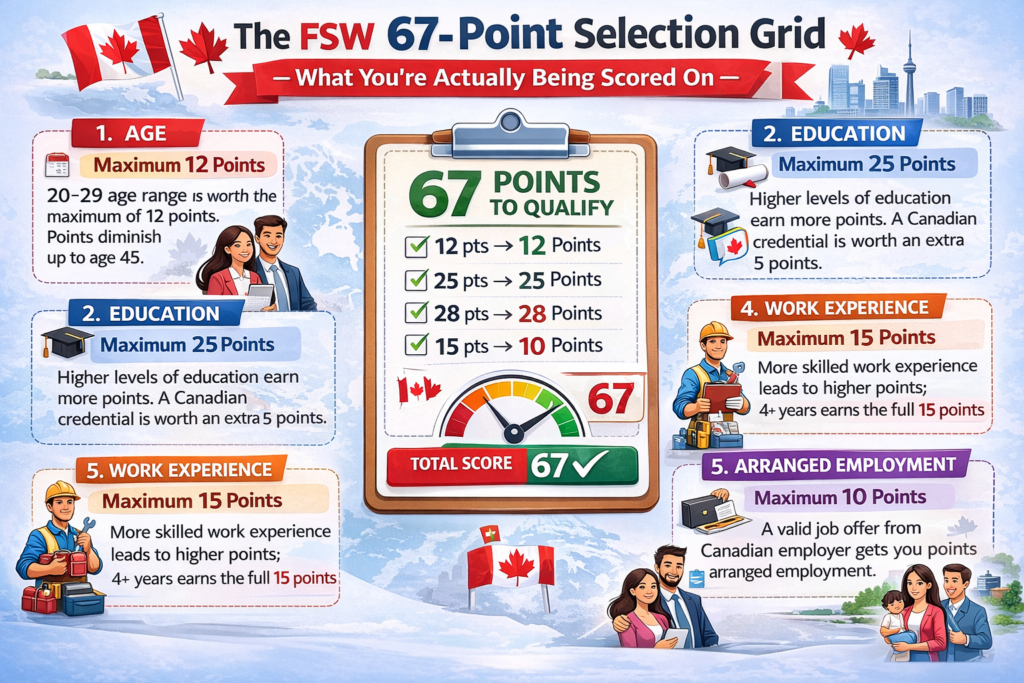
Six factors. 100 possible points. You need 67. Here’s what each one means and — more importantly — how to maximize it.
Language Proficiency (up to 28 points) This is the biggest single factor on the FSW grid, and it’s where most applicants can make the biggest gains. Your score is based on your lowest CLB level across Speaking, Listening, Reading, and Writing — so one weak skill drags down your whole language score. CLB 10+ in all four skills gets you the maximum 28 points. CLB 7 gets you 16. That gap is huge, and it’s why retaking a language test is often the first advice any immigration professional gives.
Education (up to 25 points) A PhD scores 25 points. A master’s or professional degree gets 23. Bachelor’s and three-or-more year credentials sit at 20. The key thing most people don’t realize: if your education is from outside Canada, you must have an Educational Credential Assessment (ECA) from a designated organization. Without one, your foreign degree doesn’t count at all in the FSW calculation. This trips people up constantly.
Work Experience (up to 15 points) Four or more years of continuous skilled work in a NOC TEER 0, 1, 2, or 3 occupation maxes you out at 15 points. One year gets you 9. The work can be Canadian or foreign — both count here, unlike in CEC where only Canadian experience matters.
Age (up to 12 points) If you’re between 18 and 35, you get the full 12 points. After 35, it drops by 1 point per year. At 47 or older, you get zero. It’s the one factor you genuinely can’t change, which is exactly why it’s worth maximizing everything else first.
Arranged Employment (up to 10 points) A valid Canadian job offer supported by an LMIA or exempt from LMIA requirements adds 10 FSW points plus 50–200 CRS bonus points on top. It’s worth pursuing, though getting an LMIA-supported offer is genuinely competitive. If you have one, make sure to use it.
Adaptability (up to 10 points) This is the factor most applicants underestimate. Points are available for: your spouse’s language ability (5 pts), past Canadian work experience (10 pts), Canadian post-secondary study (5 pts), a relative in Canada (5 pts), and your spouse’s Canadian education (5 pts). The category is capped at 10 regardless of how many you qualify for — but a lot of people leave these on the table without realizing it.
FSW vs CEC vs FST — Which Express Entry Stream Is Right for You?
Honestly, the right answer depends entirely on your personal profile. Let me break it down plainly.
Federal Skilled Worker (FSW) Best for: skilled workers applying from overseas, or candidates in Canada who don’t yet have 1+ year of Canadian work experience. Requires a 67-point grid score. Foreign work experience counts. ECA required for non-Canadian credentials.
Canadian Experience Class (CEC) Best for: people already working in Canada with at least 1 year of skilled Canadian work experience. No points grid — just a binary eligibility check on work experience and language. Historically lower draw cutoffs for CEC-specific rounds. Faster and simpler if you qualify.
Federal Skilled Trades (FST) Best for: candidates in regulated or non-regulated skilled trade occupations (NOC TEER 2 and 3 trades). Has its own eligibility requirements including a job offer or certificate of qualification, plus specific language minimums. Less common but genuinely useful for the right candidate.
Here’s the practical reality: if you have Canadian work experience, use CEC. If you don’t, FSW is likely your path. Some candidates qualify for both — and that’s actually an advantage, because it means you’re eligible for more draw types, including all-program draws and potentially category-based rounds.
Our FSW points calculator is specifically built for the FSW stream, but it also generates your full CRS score — so you get a complete picture of your standing in the Express Entry pool regardless of which stream you enter through.
Do You Actually Qualify for FSW? The Non-Negotiable Requirements
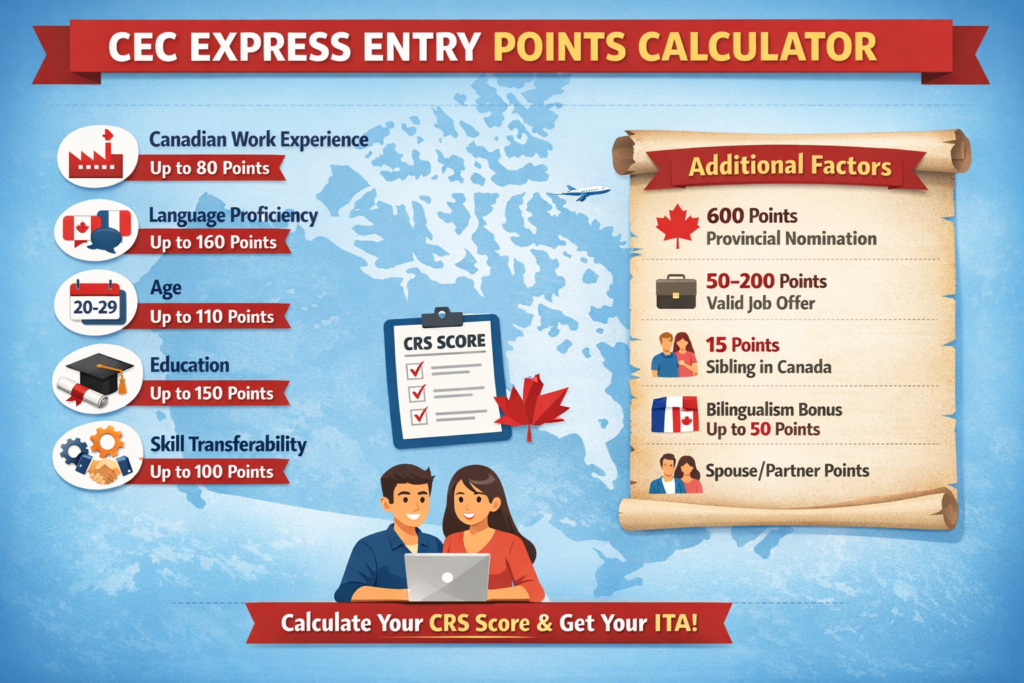
Before the 67-point grid even matters, there are a few baseline requirements you need to meet:
Skilled Work Experience You need at least 1 continuous year of full-time (or equivalent part-time) skilled work experience in the last 10 years. Has to be in a single NOC TEER 0, 1, 2, or 3 occupation. Self-employment counts in some cases — speak to a professional if that applies to you.
Language Test You must take an approved language test. For English: IELTS General Training or CELPIP-G. For French: TEF Canada or TCF Canada. The minimum is CLB 7 in all four skills. No test, no Express Entry profile — simple as that.
Minimum Education If you’re claiming education points, your foreign credential needs an ECA. Canadian credentials don’t require this. Getting an ECA takes time — factor this into your planning before you submit.
Proof of Funds Unlike some other streams, FSW requires you to show proof of settlement funds unless you already have a valid Canadian work permit. The amount depends on family size and is updated annually by IRCC.
Intent to Live Outside Quebec FSW is a federal program. If you intend to settle in Quebec, you’ll need to apply through Quebec’s own immigration system, not Express Entry FSW.
5 Proven Ways to Boost Your FSW Points
1. Retake your language test. Hands down the most impactful move for most FSW applicants. Language is worth up to 28 FSW points plus up to 48 CRS points. Someone scoring CLB 7 on language gets 16 FSW points; someone scoring CLB 10+ gets 28. That 12-point gap can be the difference between qualifying and not. Use our FSW points calculator to model what a higher language score does to your total before you book the test.
2. Get your ECA sorted early. If your education is from outside Canada, don’t delay the Educational Credential Assessment. It takes time — sometimes months — and you can’t include your education in your FSW points without it. Start the process before you’re ready to submit. A lot of people are caught waiting.
3. Claim every adaptability point available. Ten points are available here and a lot of people ignore them. Has your spouse tested their English or French? Did you study in Canada? Do you have family here? Each of these factors adds points. They’re capped at 10 total, but most applicants can find 5–10 points they’re leaving unclaimed in this category.
4. Build more work experience if you’re close. Going from 1 year to 2 years of work experience adds 2 FSW points. From 3 years to 4 years adds another 2 and maxes the factor. If you’re sitting at 64 or 65 FSW points, a little more time in a skilled role might be all you need to clear 67.
5. Pursue a job offer in Canada. Ten FSW points plus 50–200 CRS bonus points. It’s genuinely one of the most valuable factors on both grids. Yes, finding an LMIA-supported offer is competitive. But if you’re working with a recruiter or have connections in a Canadian company, it’s worth explicitly asking whether they’re willing to support an LMIA.
What FSW Draw Cutoffs Actually Look Like
FSW candidates compete in two types of draws: all-program draws (which include FSW, CEC, and FST candidates together) and category-based draws (which may target specific occupations or demographics).
All-program draw cutoffs have generally ranged from around 480 to 550+ in recent years — higher than CEC-specific draws. If your CRS score sits below that range, it doesn’t mean you can’t get an ITA. It means you may need to wait for a favorable draw, improve your score, or explore whether you qualify for a category-based draw that has lower cutoffs.
One thing worth knowing: CEC candidates tend to get invited at lower scores through CEC-specific draws. If you’re an FSW applicant who later accumulates Canadian work experience, transitioning to CEC eligibility can be a meaningful strategic advantage.
The honest takeaway? Calculate your score now, understand exactly where you stand, and use that information to decide whether to submit immediately or spend a few months improving a specific factor first.
Common Questions About FSW Points Calculation
How do I calculate my FSW points? Use the free FSW points calculator at the top of this page. It covers all six selection grid factors — language, education, work experience, age, job offer, and adaptability — and shows your live score as you fill in each section. It also generates your full CRS score when you hit calculate.
What is the minimum FSW score to enter Express Entry? You need at least 67 out of 100 points on the FSW selection grid to enter the Express Entry pool through the FSW stream. There’s no minimum CRS score to enter — but a higher CRS score means you get invited sooner.
Does FSW require a job offer? No. A job offer adds 10 FSW points and 50–200 CRS bonus points, but it’s entirely optional. Many successful FSW applicants don’t have a job offer at all.
Can I use foreign work experience for FSW? Yes — this is one of the key differences between FSW and CEC. Foreign skilled work experience counts toward your FSW selection grid score. For CRS purposes, foreign experience contributes through the skill transferability factor (when combined with strong language scores).
Do I need an ECA for a Canadian degree? No. Canadian credentials are recognized without an ECA. The ECA is only required for credentials earned outside Canada.
What’s the difference between CLB and IELTS band scores? CLB (Canadian Language Benchmarks) is Canada’s standard for measuring language proficiency. Your IELTS or CELPIP scores are converted to CLB levels for immigration purposes. Our FSW calculator uses CLB levels directly — use IRCC’s conversion charts if you need to convert your test scores first.
Can I be in the Express Entry pool under both FSW and CEC? If you qualify for both streams, you’ll be considered under both simultaneously in the same Express Entry pool. Being eligible for multiple streams means you can receive ITAs from more draw types, including CEC-specific draws that often have lower cutoffs.
How long does it take after getting an ITA? Once you receive an Invitation to Apply, you have 60 days to submit a complete permanent residence application. IRCC then aims to process most complete applications within 6 months.
Two Minutes to Know Exactly Where You Stand
Most applicants spend weeks researching without ever running the actual numbers. Our FSW points calculator gives you both your selection grid score and your CRS score instantly — no email, no account, no waiting.
Know your number. Identify what to fix. Apply with a plan.
And if you want an immigration professional to review your complete profile and build a real strategy around it — that’s exactly what we do.