
Age Calculator for CRS Score
How Much Does Your Age Affect Your CRS Score?
Age is one of the few factors in the Comprehensive Ranking System that moves in only one direction — and not in your favour. Every birthday after 29 costs you CRS points. Not metaphorically. Literally, on the morning of your next birthday, your Express Entry score is lower than it was the day before.
This isn’t a minor detail. At its steepest, the decline between adjacent ages can be 11 points — roughly the equivalent of one year of Canadian work experience, or the difference between CLB 7 and CLB 8 in a single language skill. For applicants already near a draw cutoff, a birthday can genuinely matter.
Our Age Calculator for CRS does three things at once: it shows your current age points, it shows exactly how those points change year by year going forward, and it builds a full CRS estimate so you can see the age factor in the context of your complete profile.
CRS Age Points Table — Complete Chart for Every Age
These are the official CRS age points from IRCC’s scoring formula. These apply to single applicants or married applicants whose spouse is a Canadian citizen or permanent resident. Applicants with an accompanying spouse use a slightly different table.
Age 17 or younger → 0 points
Age 18 → 99 points
Age 19 → 105 points
Ages 20–29 → 110 points (maximum)
Age 30 → 105 points
Age 31 → 99 points
Age 32 → 94 points
Age 33 → 88 points
Age 34 → 83 points
Age 35 → 77 points
Age 36 → 72 points
Age 37 → 66 points
Age 38 → 61 points
Age 39 → 55 points
Age 40 → 50 points
Age 41 → 39 points
42 → 28 points
Age 43 → 17 points
Age 44 → 6 points
Age 45 or older → 0 points
A few things worth noting: The drop from 40 to 41 is the sharpest on the table — 11 points lost in a single year. From 41 to 44, points continue declining by 11 per year. At 45, the age factor hits zero and stays there regardless of how old you are.
The peak bracket (ages 20–29) all earn the same 110 points. There is no advantage to being 22 versus 27 — both score identically on this factor.
When Does IRCC Measure Your Age for CRS
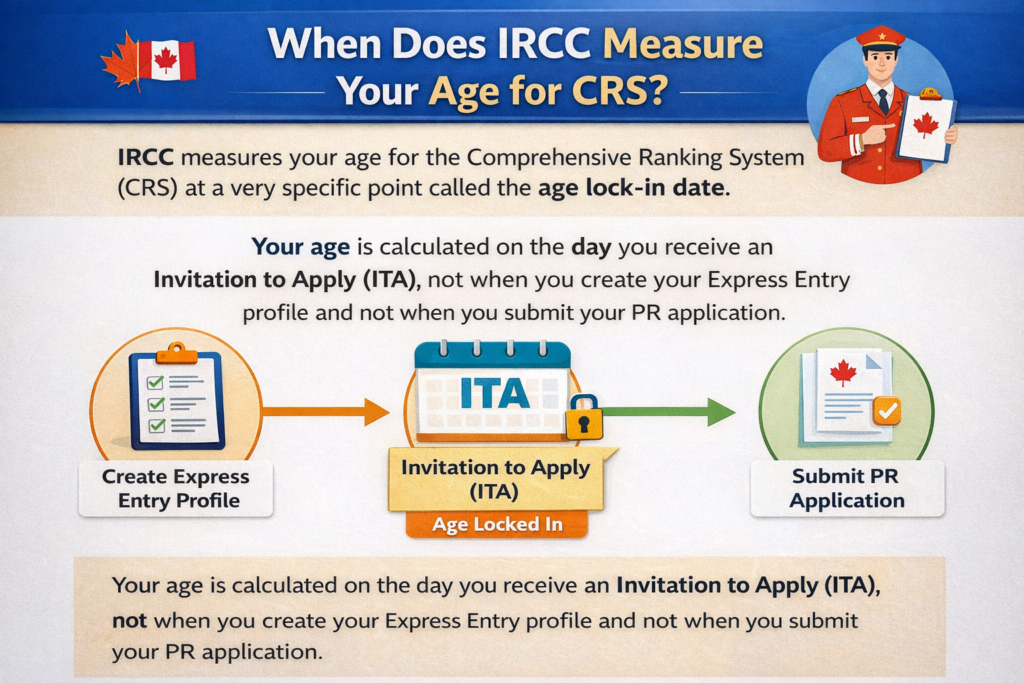
This is a detail that genuinely matters for timing decisions. IRCC calculates your age CRS points based on your age on the date you receive your Invitation to Apply (ITA) — not when you create your Express Entry profile, not when you submit your permanent residence application.
What this means in practice:
If your birthday is approaching and you’re close to a draw cutoff, submitting your profile before your birthday — and hoping for an ITA before that date — could preserve higher age points.
If your profile is already active and a draw occurs the day before your birthday, you’ll receive the ITA at your current (higher) age. If the draw happens two days later, you’d receive it at the lower age. It’s not something you can fully control, but it’s worth being aware of.
On the flip side: if you’re still building up your profile (waiting for a language test result, an educational credential assessment, or Canadian work experience to accumulate), factor in the age-point loss you’ll sustain during that waiting period. Sometimes the gain from another factor outweighs the age loss. Sometimes it doesn’t.
Age in Context — How It Fits Your Total CRS Score
Age is just one of many CRS factors. To understand how important it is for you personally, it helps to see it alongside everything else:
The CRS scoring system has four main components:
Core Human Capital Factors (for single applicants): Age → Max 110 points Education → Max 150 points First language → Max 136 points (including transferability) Canadian experience → Max 80 points Core total → Max 500 points
Spouse or Common-law Partner Factors: Education → Max 10 points Language → Max 20 points Canadian experience → Max 10 points Spouse total → Max 40 points
Skill Transferability Factors: Education + language/experience → Max 100 points
Additional Points: Provincial nomination → 600 points Job offer → Up to 200 points Canadian siblings → 15 points French + English bilingualism → Up to 50 points
Age at 110 points is 22% of the core factors maximum of 500. It’s significant — but not dominant. A 35-year-old with 77 age points and CLB 9 language (48 pts) is actually scoring more in these two categories combined than a 25-year-old with 110 age points and CLB 5 (24 pts).
The practical takeaway: age matters, but it can be offset. Language improvement, Canadian work experience, education credentials, and especially a provincial nomination can all compensate meaningfully for age-related CRS decline.
CRS Age Strategy — What to Do Based on Your Age Group
Ages 18–29 — You’re at Peak Age Points
You’re earning the maximum 110 CRS age points. This won’t last forever — the decline begins the moment you turn 30. The best use of this window is to build the factors that don’t have an expiry date: language scores, education credentials, and Canadian work experience.
If you’re a student or recent graduate, now is the time to take your language test and aim for CLB 9+. If you’re working in Canada on a temporary permit, accumulate Canadian work experience to qualify for CEC or boost your CRS through the Canadian work experience factor.
Don’t assume your age advantage means you can wait. The gap between your 20s and your 30s in CRS terms is 5–11 points per year. Start your profile as soon as your other factors are in reasonable shape.
Ages 30–34 — High Zone, Points Still Strong
You’ve left the peak bracket but you’re still earning strong age points — between 83 and 105. Your age is an asset, just a declining one. The strategic calculus is simple: every year you delay, you lose 5–6 CRS points.
Weigh every delay carefully. If waiting 6 months for a language test result gains you 8 language points but loses you 5–6 age points, the net gain is still positive. But if the wait is a year and the gain is only 4 points, you’re moving backwards on net.
This age group still has enough time to build strong profiles through conventional means. Prioritise language, lock in any pending educational credential assessments quickly, and consider whether any PNP streams match your profile — getting a nomination in your 30s removes age as a concern entirely.
Ages 35–39 — Declining Zone, Act Strategically
Age points are dropping meaningfully — from 77 at 35 down to 55 at 39. If your current CRS score isn’t near draw cutoffs, a provincial nomination becomes increasingly important.
The good news is that many applicants in this range have substantial work experience, which adds real CRS points through both the direct work experience factor and transferability bonuses. Years of skilled work experience, combined with strong language, can still build competitive profiles.
Explore PNP streams actively at this stage. Provinces with streams that don’t prioritise younger applicants — Saskatchewan, New Brunswick, and Atlantic provinces often among them — may be worth investigating specifically.
Ages 40–44 — Critical Zone, PNP Is Essential
The age factor drops sharply through this range — from 50 points at 40 down to just 6 points at 44. At 45, it hits zero. Waiting any longer costs disproportionately.
For applicants in this age group, a provincial nomination is not just a helpful boost — it’s typically the only realistic path to an ITA through Express Entry. The 600 CRS points from a PNP completely neutralise the age factor and place any profile above historical draw cutoffs.
If PNP isn’t immediately accessible, investigate category- based Express Entry draws, which sometimes have lower cutoffs for specific occupations. Healthcare workers, French speakers, and tradespeople have all benefited from category draws with cutoffs well below all-program averages.
Age 45 and Older — Age Points Are Zero
At 45 and above, the CRS age factor is 0. There is nothing you can do about this specific factor. The path to PR requires compensating through other means.
A provincial nomination remains the most powerful tool available. It adds 600 CRS points regardless of age — effectively removing age from the equation. Base PNP streams that operate outside of Express Entry are also worth exploring, as they don’t involve CRS scoring at all.
French language skills are disproportionately valuable for older applicants. Category-based draws targeting French speakers have had lower cutoffs, and bilingualism bonuses add up to 50 CRS points that have no age dependency.
What Can Offset Declining Age Points in CRS?
Here are the most effective ways to compensate for age- related CRS point loss, in order of impact:
- Provincial Nominee Program (PNP) — +600 points A provincial nomination adds 600 CRS points instantly. This is the single most powerful offset for any CRS weakness, including age. It doesn’t matter if you’re 35 or 55 — +600 puts virtually any profile above draw cutoffs. This should be explored first and aggressively for applicants whose age factor is declining.
- Language improvement — up to +16 points from CLB 7 to 9+ Going from CLB 7 to CLB 9+ across all four skills adds 16 direct language CRS points. This is achievable through dedicated preparation and test retakes. It won’t offset severe age decline alone, but combined with other factors, it adds up.
- Canadian work experience — up to +80 direct + transferability One year of Canadian skilled work adds 40 CRS points. Two years adds 53. Beyond that, transferability bonuses stack on top. For applicants already in Canada on work permits, accumulating experience is one of the most productive uses of time — even though time also costs age points.
- Education credentials — up to +140 points If you haven’t yet submitted your Educational Credential Assessment (ECA) for a foreign degree, doing so and claiming the right education level in your profile can add substantial CRS points. A Master’s degree earns 126 education points; a PhD earns 140.
- Sibling in Canada — +15 points If you have a brother or sister who is a Canadian citizen or permanent resident, you receive 15 additional CRS points. This is a straightforward bonus with no requirements beyond the family relationship.
- French bilingualism bonus — up to +50 points Strong French at NCLC 7+ qualifies for a bilingualism bonus of 25–50 points. If you speak French and haven’t tested, this is worth doing.
Age & CRS — Frequently Asked Questions
Is there a maximum age for Express Entry?
No. Express Entry does not have an age cutoff. You can apply at any age. However, the CRS age factor is 0 for applicants aged 45 and above — meaning age contributes nothing to your CRS score. Older applicants typically need to compensate through strong language scores, work experience, education, or a provincial nomination.
At what age do CRS age points start dropping?
Age points begin declining when you turn 30. Between ages 20 and 29, the point value is constant at 110. At 30 it drops to 105, and it continues declining each year until it reaches zero at age 45.
How many CRS points do I lose each birthday?
The loss varies by age: Turning 30: lose 5 points (110 → 105) Turning 31: lose 6 points (105 → 99) Turning 32–35: lose 5–6 points per year Turning 36–40: lose 5–6 points per year Turning 41–44: lose 11 points per year (steepest drop) Turning 45: lose remaining 6 points (6 → 0)
Does my age change automatically in my Express Entry profile?
No — your Express Entry profile does not automatically update your age. IRCC calculates your age on the date you receive an ITA. Your profile doesn’t need to be updated every birthday; the system determines your age at the time of invitation.
Does age affect FST, CEC, and FSW eligibility?
Age is not a hard eligibility criterion for any Express Entry stream — it’s purely a CRS scoring factor. Being over 45 doesn’t disqualify you from FSW, CEC, or FST. It simply means you earn 0 CRS points from the age factor, making it harder to receive an ITA through a general draw without other strong factors or a PNP.
Can I still get PR if I’m over 40?
Yes. Many applicants over 40 receive Canadian permanent residence every year. The path typically involves either a provincial nomination, strong Canadian work experience, high language scores, or category-based Express Entry draws targeting specific occupations or French speakers. Age is a hurdle, not a wall.
Does my spouse’s age affect my CRS score?
Your spouse’s age is not a separate CRS factor. However, if your spouse is accompanying you, you enter the Express Entry pool as a couple — and in that case, the CRS formula uses your age (the principal applicant’s age), not your spouse’s. Your spouse’s education, language, and Canadian work experience add separate CRS points through the spouse factors section.
What’s the best age to apply for Express Entry?
The best time to apply is when your profile is as strong as possible — strong enough to receive an ITA in a reasonable timeframe. In general, applying as early as you can with a competitive profile is better than delaying to strengthen one factor, because age is always declining. If you’re in your late 20s with a reasonable profile, applying soon and improving other factors while waiting in the pool is often the better strategy.
Calculate Your Full CRS Score — Not Just Your Age Points
Our Age Calculator above shows your age factor in detail — but age is one factor out of many. Use our full CRS Score Calculator to see your complete estimated score across every element of the Comprehensive Ranking System: age, education, language, Canadian experience, transferability, spouse factors, and all bonus points.
If you’re concerned about your age factor, our PNP Points Calculator shows exactly what a provincial nomination does to your score — with a +600 point boost that offsets age decline entirely.